
The basics of serving, scoring, and the kitchen — everything you need to play a match.
The serve is the first shot that starts a rally. In pickleball, the only legal serve is an “underhand serve” — swung upward from below waist height. That makes it easy for anyone to start playing right away.
Who serves first is decided by a fair method, such as a coin toss or rock-paper-scissors. The winner chooses whether to serve or receive, and which side of the court to start on — and may hand either choice to the opponent instead.
Scoring is simple, but keeping track of which player serves from which side of the court can be a little confusing at first. Once you know these four points, you won’t lose track during a match.
The same server switches sides and serves again. As long as your team keeps scoring, you keep serving.
No point is awarded — instead, the right to serve simply passes to the other team. This is called a “side out.” Your position on the court doesn’t change.
Only on the first serve of each game, the serving team gets just one server instead of two. If that serve is lost, the ball goes straight to the other team. Both players get to serve from then on.
Just remember: if your team’s score is even (0, 2, 4…), stand on the right; if it’s odd (1, 3, 5…), stand on the left. Check the score and you’ll always know where to be.
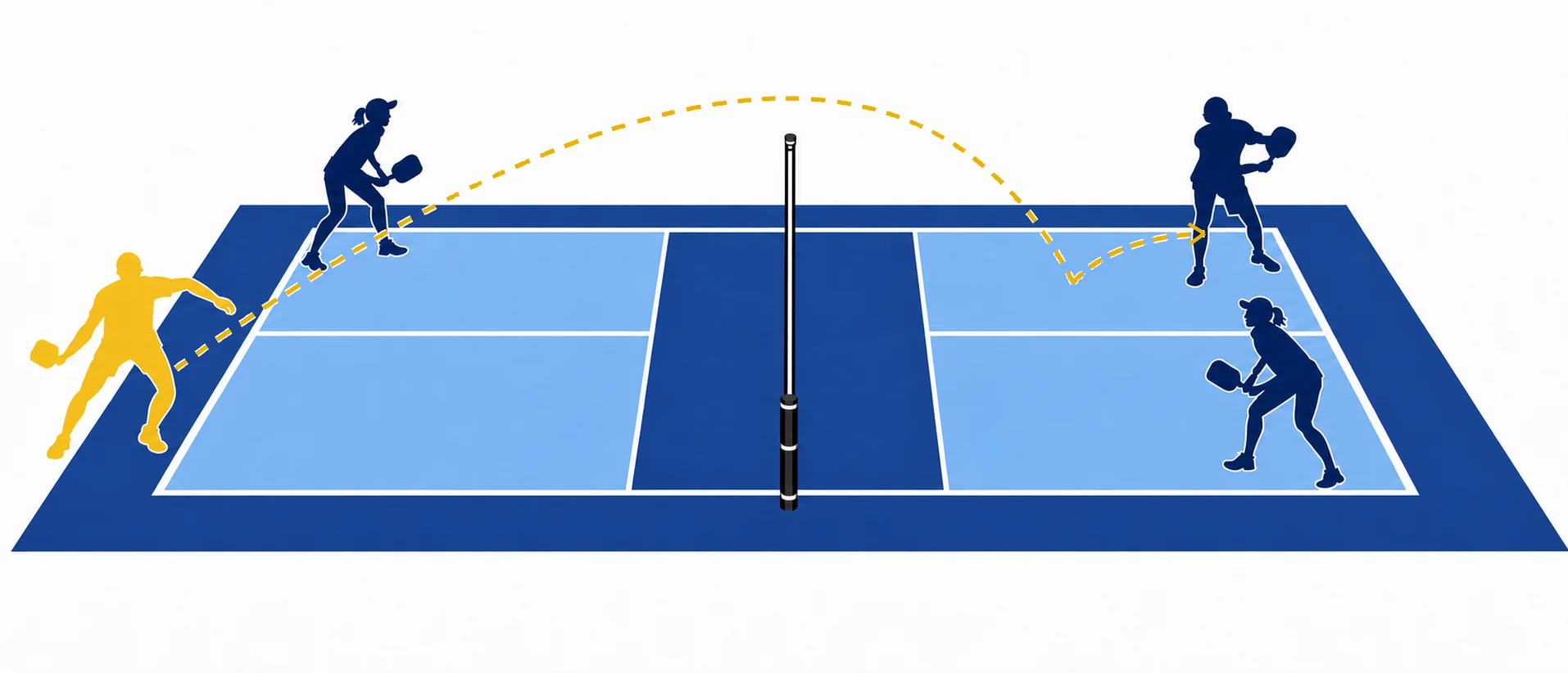
The player highlighted in yellow is the one about to serve, hitting an underhand serve diagonally into the opponent’s service area.
Pickleball uses “side-out scoring”: only the serving team can score a point. If the receiving side wins the rally, no point is scored — the serve simply passes over.
The serving team’s score
The receiving team’s score
Whether the first or second server is currently serving
It might look a little odd, but every game’s score starts at “0-0-2.” Since only one player on the serving team gets to serve at the very start of a game, the count begins as if that player were already the “second server.”
After the serve, the ball must bounce once on the receiving side before it can be returned. The same applies to the return shot: it must bounce once on the server’s side before it can be volleyed (hit before it bounces). In short, neither the serve nor the very next return may be volleyed — both must be allowed to bounce.
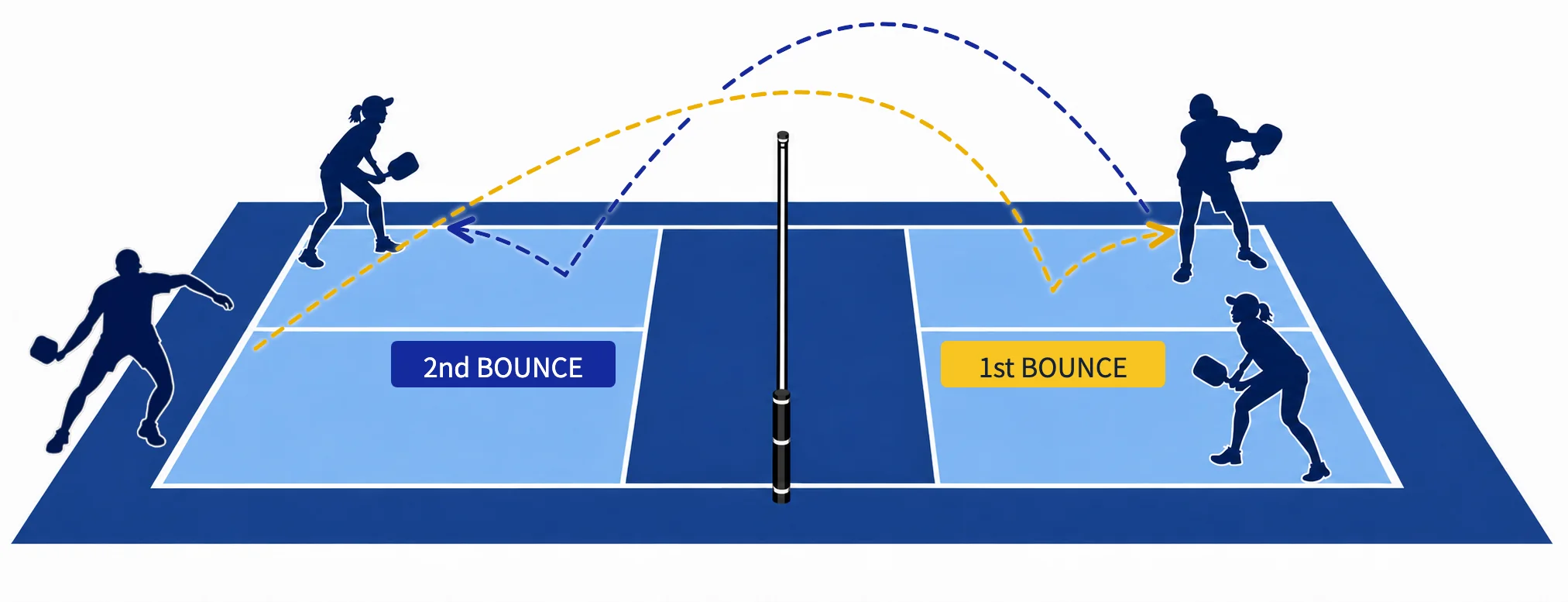
Wait for the 1st bounce after the serve, and the 2nd bounce after the return, before hitting the ball.
The 2.13m-deep area on either side of the net is called the “non-volley zone,” better known as “the kitchen.” Volleying (hitting the ball before it bounces) while any part of your body is touching this zone is a fault. This rule keeps players from winning points on power alone, and is a key part of what gives pickleball its strategic, back-and-forth feel.
| Situation | Description |
|---|---|
| Kitchen Violation | Volleying while your foot, hand, or paddle touches the non-volley zone |
| Out of Bounds | The ball lands outside the court lines |
| Net Fault | The ball fails to clear the net, or a player’s body or paddle touches the net |
| Two-Bounce Violation | Volleying the serve or the very next return before it has bounced |
| Foot Fault | Stepping on or over the baseline or sideline while serving |
Any mistake that ends a rally — an out ball, a net fault, and so on — is collectively called a “fault.” It’s normal to be unsure about close calls at first; ask more experienced players around you, and you’ll pick it up quickly.
Once you understand the rules, see Court to see how the kitchen and court dimensions fit together.
 Pickleball Japan